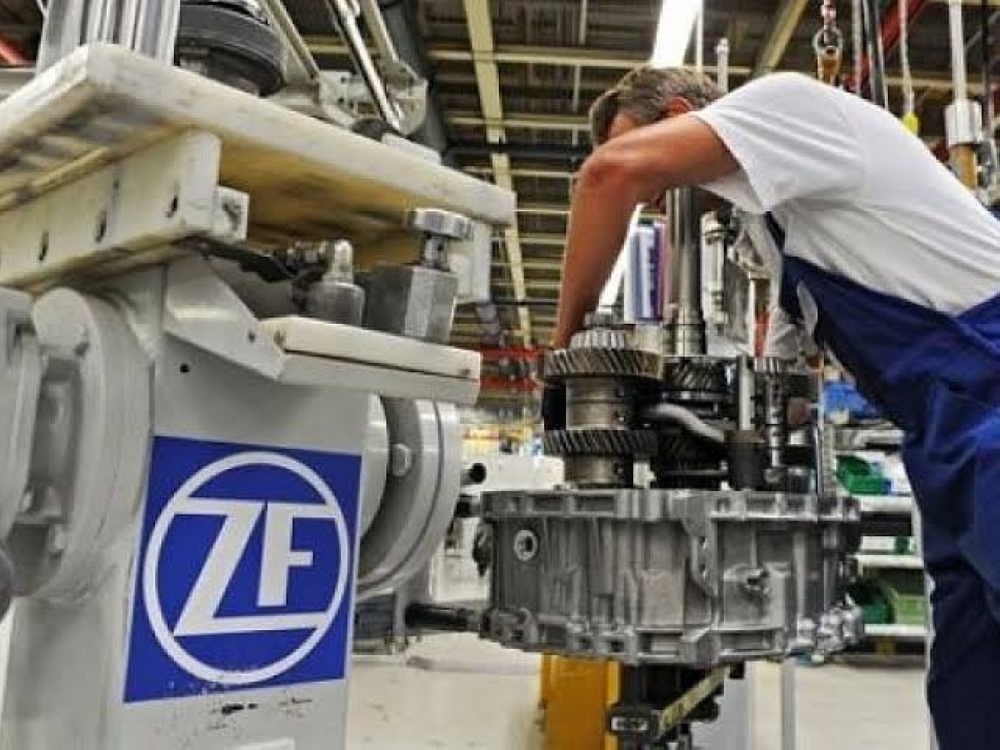


Few German cities are feeling the crisis in the automotive industry more acutely than Friedrichshafen, which sits on the picturesque shores of Lake Constance. For more than a century, life here has been intertwined with ZF Friedrichshafen, a major supplier of transmissions and other auto parts.
To call it a “company town” doesn’t quite do justice to the relationship. Through a foundation, the city owns more than 90% of ZF, which is also the area’s largest employer. In good years, profits from ZF supplied the city with more than 100 million euros annually for swimming pools, kindergartens and even a bridge.
But that largess has withered away.
ZF is suffering from a major industrial upheaval because of the rocky global shift to electric vehicles and intense competition from Chinese automakers. Last year ZF lost 2.1 billion euros, or $2.3 billion. The company is cutting up to 14,000 jobs in Germany, about a quarter of its domestic workforce.
Profits that ZF funneled to the foundation dwindled to 41 million euros last year and will be zero this year. The money is not expected to begin flowing again until the end of the decade, at the earliest.
Friedrichshafen, where tourists stroll the banks of the lake that sits between Germany and Switzerland, has had to cut back services that many people took for granted. Last year parents staged a protest outside city hall after childcare fees, which were largely paid for by ZF profits, jumped to 450 euros per month from 158 euros.
“We used to benefit a lot” from the foundation, Simon Blümcke, the city’s mayor since 2024, said in an interview. His predecessors could afford private drivers. Blümcke, who also sits on ZF’s supervisory board, has cut that luxury as well as projects like a planned railroad underpass.
“Now,” he added, “we are completely redoing our municipal strategy.”
Variations of this scenario are playing out across Germany. It is unusual for a city to own such a large company. But it is not unusual for local economies to revolve around a single large manufacturer.
Stuttgart has Mercedes-Benz, which is asking workers to put in extra hours without extra pay and last month issued a profit warning. The city is also home to Porsche, whose profit has all but evaporated. Munich has BMW, which plans to cut 20% of its managers. Wolfsburg revolves around Volkswagen, which is cutting up to 100,000 jobs and may close four German factories.
Outside those major cities, countless smaller communities depend on suppliers, which form the backbone of the German economy. The state of Baden-Württemberg, which includes Friedrichshafen, has a particularly dense concentration of these specialized “Mittelstand” companies.
The challenges facing Volkswagen, Mercedes and BMW reverberate at suppliers like ZF. The number of people employed in German auto manufacturing has fallen to 691,500 this year from 834,000 in 2018, according to official figures. Experts expect the number to continue to decline.
The problems of the auto industry feed into a general economic malaise, which has fueled popular support for far right political parties. In the state of Saxony-Anhalt to the east, the right-wing Alternative for Germany has become the largest party.
The AfD’s appeal in Friedrichshafen has been held back by the party’s failure, so far, to articulate a cohesive and appealing plan for the car industry. The party calls for promoting internal combustion engines, but nearly half of Germans who registered a new car in September chose an electric vehicle or a plug-in hybrid.
Still, in March the AfD doubled its vote in Friedrichshafen from the previous elections, to 20%, behind the Christian Democrats and Greens but ahead of the Social Democrats, traditionally a champion of workers.
ZF’s dominant shareholder, with a 94% stake, is the Zeppelin Foundation, a nonprofit organization that uses the company’s profits for the good of the community. The foundation’s name stems from Ferdinand, the Count of Zeppelin, a retired general who developed the airships known by the same name.
After a test flight in 1908 ended in flames, local people raised money to keep the project alive. In gratitude, the count founded the Zeppelin Foundation.
The airship business collapsed in 1937 after the Zeppelin Hindenburg famously exploded in Lakehurst, New Jersey. But the company had already developed a side business making gears for cars and trucks. ZF stands for Zahnradfabrik, or “gear factory.”
The company grew to become one of the world’s largest automotive suppliers, known for selling transmissions to BMW and others. ZF has 150,000 employees worldwide, including almost 9,000 in the United States.
In 2018, the Zeppelin Foundation funneled 192 million euros to the city. Though formally separate from the municipal budget, the foundation underwrote projects that would normally be financed by tax revenue, including a pedestrian bridge over a highway.
But the pandemic undercut car sales in Europe, which have yet to completely recover. ZF is focusing on paying down its 10 billion-euro debt, which it accumulated during an acquisition binge that included the $13 billion purchase, in 2014, of U.S. parts maker TRW. The expansion has left ZF in a precarious financial position.
“We have one big problem,” Mathias Miedreich, ZF’s CEO since last year, said in an interview. “Our debt.”
ZF also invested heavily in new technologies like an autonomous shuttle that found no customers. A division that produces automotive components, including motors for electric vehicles, is ZF’s largest unit by revenue but has struggled with uneven demand. In a blow to German prestige, the company has transferred research and development for electric vehicles to China.
The growth of Chinese automakers has not been all bad for ZF. The company supplies Chinese manufacturers and benefits from their increasing sales around the world. But ZF also faces competition from Chinese suppliers.
“The rise of the Chinese carmakers is not without risk, but if we do it right, it can be a chance for us,” Miedreich said.
In Friedrichshafen, ZF employs 8,700 people, including 5,500 manufacturing workers who produce gears for trucks and buses. Many work in Hall 9, known sarcastically as Hell 9 because it reeks of rubber and hot metal.
Workers have become restive after the company cut bonuses that once accounted for up to 13% of their monthly pay. At a companywide meeting in July, workers booed the head of personnel, Lea Corzilius, so loudly that she was unable to speak.
German law gives workers rights that make it difficult for companies to quickly dismiss them. This year the company’s works council, which represents employees, prevented the company from scheduling overtime and Sunday shifts until management agreed to a compromise that tied bonuses to profitability.
Some German managers complain that rules giving workers a say in major decisions are hurting the country. When German automakers or large suppliers build new factories, they often put them in countries like Hungary, where wages are lower.
The German system, Miedreich said, has merit because it motivates workers and managers to work together. But he added, “Like all things that were good in the past, it doesn’t mean they should continue in the same form. Everyone has to change.”
ZF’s workers say they are being forced to absorb the brunt of cost cuts. Pay cuts, including a reduction in the workweek for midlevel managers, have made it more difficult to afford housing in Friedrichshafen, where prices are already high because of the picturesque city’s appeal to second-home buyers.
“We used to be a wealthy city,” said Ingrid Schmid, 61, who works in a shoe store that was already struggling to deal with online competition. Business is good during the tourist season, she said, but in winter, when business depends on local residents, “you might as well roll up the sidewalks.”
This article originally appeared in The New York Times.
Oman Observer is now on the WhatsApp channel. Click here